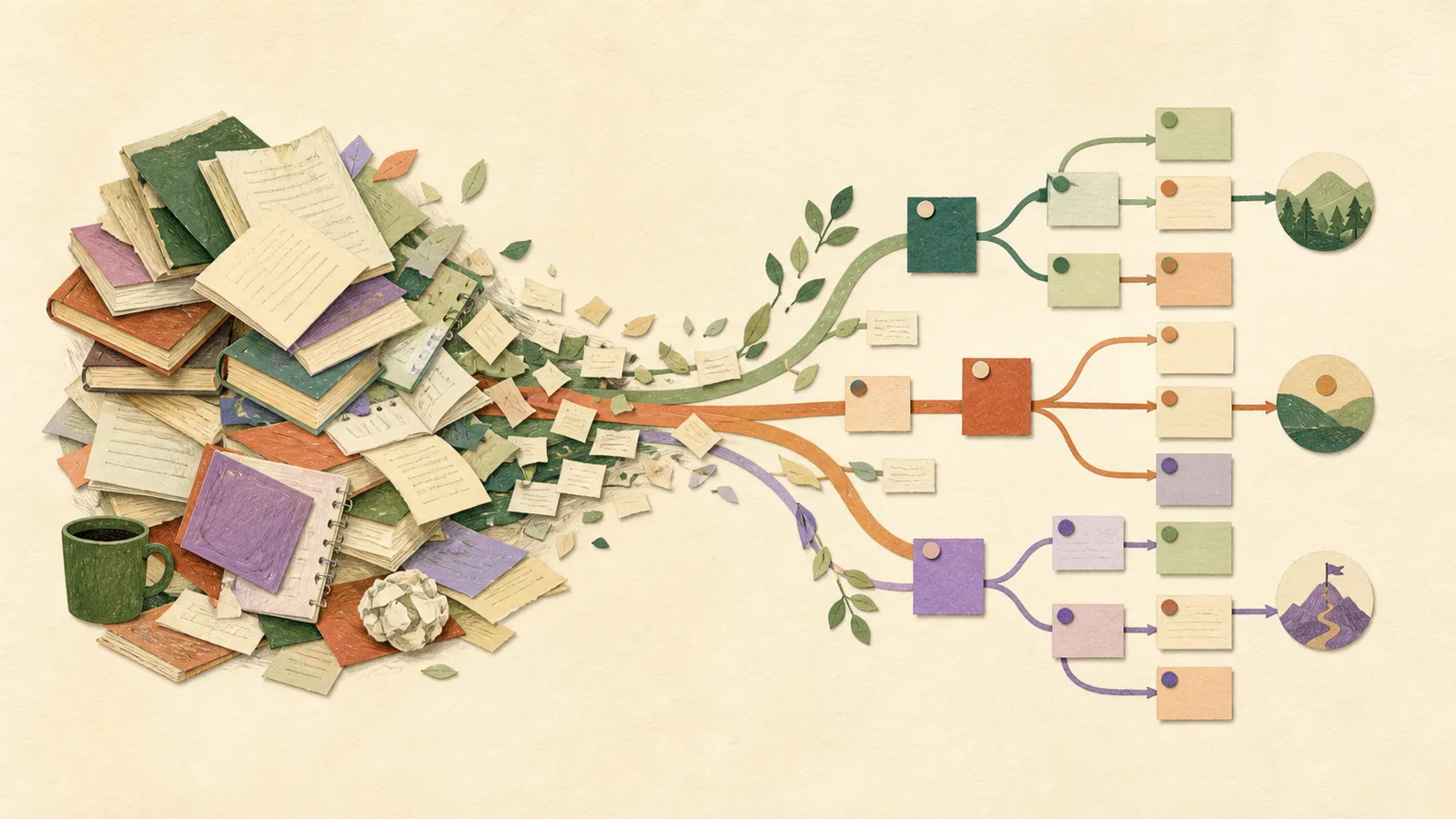
“Learn data science” looks reasonable on a goals list. It becomes much less reasonable at 7:30 on Tuesday evening, when you open a laptop and have to decide what learning data science means right now. Watch a lecture? Install Python? Read about regression? Find a project? The goal is so large that choosing becomes work of its own.
The fix is not a prettier timetable. It is to replace the large noun with a set of visible abilities. A useful study plan tells you what you are trying to become able to do, what comes first, and what the next session contains. It is specific enough to begin and loose enough to survive contact with reality.
Begin with an outcome you could demonstrate
Write one sentence that describes evidence, not aspiration. “Understand statistics” is difficult to verify. “Choose and explain an appropriate statistical test for a basic research question” gives you something to aim at. For a language, the outcome might be “hold a ten-minute conversation about work and weekends.” For history: “explain the causes and consequences of the 1848 revolutions without notes.”
This outcome is not a permanent contract. It is a boundary. It stops an introductory plan from quietly expanding until it contains an entire university degree. If you discover that the outcome was too broad, narrow it. A plan that changes after you learn more is working correctly.
Make a rough map before making a schedule
List the major areas that sit between you and the outcome. Do this quickly, with a syllabus, table of contents, course outline, certification guide, or advice from someone competent in the field. At this stage you are looking for shape, not completeness.
A beginner map for web development, for example, could contain:
- how the web and browsers work;
- HTML structure and accessible content;
- CSS layout and responsive design;
- JavaScript fundamentals and the DOM;
- forms, network requests, and errors;
- version control, deployment, and one small project.
Notice what is missing: every framework, every database, every design trend, every possible deployment platform. Those may matter later. They do not all belong in the first map.
Turn areas into learning items
A learning item should fit inside one or a few focused sessions and end in an observable action. “CSS” is still a category. “Build a two-column layout with Grid and make it collapse cleanly on a narrow screen” is an item. “The French past tense” is a category. “Choose between passé composé and imparfait in ten short situations” is an item.
Use verbs that expose the work: explain, compare, solve, identify, build, translate, diagnose, sketch, recall, or teach. “Read chapter four” may be part of the process, but finishing a chapter says little about what became usable.
A simple quality check
A learning item is probably the right size when you can answer all three questions:
- What will I do during the session?
- What will I produce or attempt?
- How will I know whether another pass is needed?
Mark prerequisites, not just priorities
Some topics are important because everything else depends on them. Others are important but can wait. Draw arrows or write “needs” beside items with real prerequisites. Fractions may need to come before algebraic manipulation; basic sentence order before complex conversation; variables and functions before an API project.
Do not over-engineer the dependency graph. You only need enough structure to avoid repeatedly crashing into knowledge you have not learned yet. When two items can be learned independently, let interest or an upcoming deadline decide the order.
Separate coverage from mastery
A first encounter is not mastery, and pretending otherwise creates fragile plans. Give each item a plain status such as:
- Exploring: you are building the first mental model;
- Practising: you can attempt the skill but still need prompts or correction;
- Solid: you can retrieve or use it under the conditions that matter to your goal.
“Solid” does not mean permanently complete. Memory changes and advanced work reveals gaps. It simply means the item no longer needs to lead your weekly plan. This distinction prevents the satisfying act of checking boxes from replacing learning.
Plan one week, not your fantasy semester
Long-range plans are useful for direction and unreliable for detail. Keep the full map, then choose a small weekly slice: perhaps two new items, one practice item, and one review. Put those into the time you genuinely have, including the short weekday slot you tend to dismiss as “not enough.”
Match the task to the block. A twenty-minute slot can hold flashcard review, one worked example, or a short recall dump. A ninety-minute block can hold a difficult problem set or project build. Do not force every kind of learning into identical rectangles.
At the end of the week, ask what moved, what got stuck, and what was incorrectly sized. Carry the useful information forward. Do not copy the entire failed schedule and call it discipline.
Use resources as tools, not as the plan
It is tempting to collect three courses, five books, twenty videos, and a folder of PDFs before beginning. Resource collecting feels like progress because the decisions are easy and the possibilities remain perfect. The map should control the resources, not the other way around.
Choose one primary explanation for each area and one backup when the first does not click. Attach resources to learning items. If a video, chapter, or exercise does not help you complete an item, it is probably optional.
Build retrieval into the map
A good plan does not end at input. It includes chances to recall, explain, or use the material without looking. A major review of common learning techniques rated practice testing and distributed practice highly across many contexts, while highlighting and rereading were much less dependable on their own. The practical lesson is modest: schedule attempts, not only exposure.
For each major area, add at least one retrieval task: a blank-page explanation, a short quiz, a worked problem without an example beside it, a conversation prompt, or a miniature project. When that attempt reveals a gap, return to the exact section that repairs it.
 Keep the map somewhere you will actually use itOffShelf lets you turn a topic into learning items, mark each one Exploring, Practising, or Solid, schedule work, and open notes, flashcards, quizzes, or a focus session from the same topic.See OffShelf
The thirty-minute version
If planning the plan has become another form of delay, set a thirty-minute limit. Write one demonstrable outcome. Find one trustworthy outline. Create six to twelve learning items. Mark obvious prerequisites. Choose the first two items and schedule the first session. Then stop planning and begin.
Your map will be imperfect because you are a beginner mapping unfamiliar ground. That is fine. Its first job is not to predict the whole journey. Its first job is to make tonight’s work obvious.