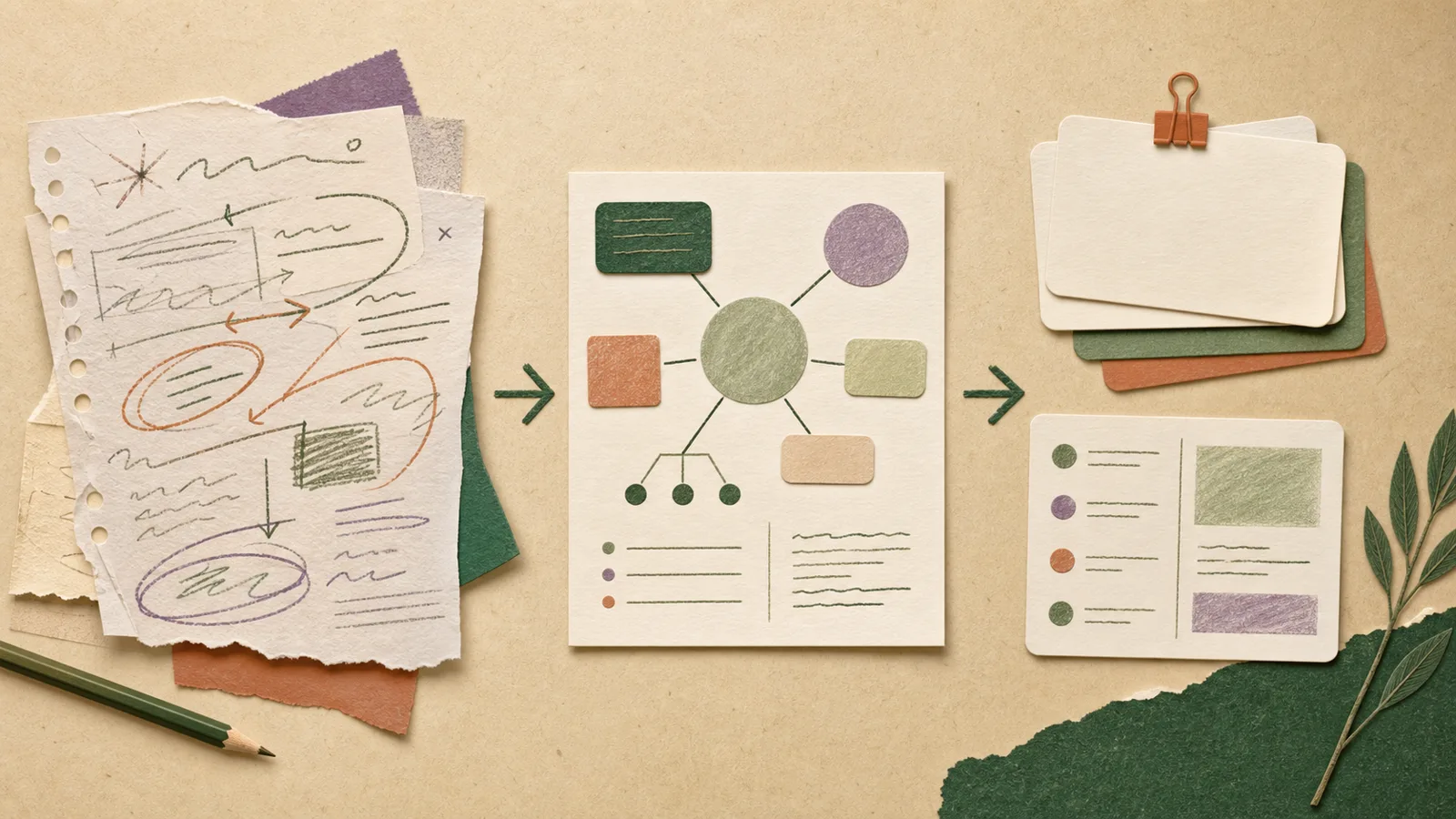
Lecture notes often contain sentences that made perfect sense at 11:14 and look like fragments from a damaged transmission two weeks later. An arrow points nowhere. “Important” is underlined three times. A worked example skips the step the lecturer explained aloud.
That is not a failure of note-taking. Live notes are a capture layer made under time pressure. The failure is expecting that layer to become useful review material without another pass.
During the lecture, capture structure and uncertainty
Do not attempt a transcript unless one is required as an accommodation. Listen for the question the lecture answers, major sections, definitions, examples, contrasts, and points the instructor emphasizes. Mark uncertainty immediately with a symbol such as “?” so it remains findable.
Use abbreviations you will recognize. Leave space when you miss something instead of abandoning the next five minutes to repair one sentence.
Within a day, reconstruct before editing
Before reopening slides or recordings, spend three minutes writing what you remember: the central argument, sequence, or model; the strongest example; and what remains unclear. This quick retrieval gives the notes a purpose. You are no longer cleaning everything equally—you are checking a remembered structure.
Then read the notes once. Expand cryptic abbreviations, finish broken arrows, label examples, and correct obvious errors against the source. Do not recopy them into decorative perfection.
Write the lecture in five sentences
Force a compact account: what problem was introduced, what central idea answered it, how the parts relate, what evidence or example mattered, and what limitation or question remains. Five sentences may be too few for the whole course; that is why they are useful for one lecture.
If you cannot compress a section without copying, you have identified material to relearn.
Convert headings into retrieval questions
“Neural transmission” becomes “How does a signal move from one neuron to the next, and where can the process be interrupted?” “The CAP theorem” becomes “Which guarantees cannot all be provided during a network partition, and what trade-off follows?”
Answer from memory before checking the notes. Keep a handful of high-value questions rather than converting every bullet into a card.
The twenty-minute second pass
- Recall the lecture for three minutes without notes.
- Repair unclear capture for five minutes.
- Write a five-sentence summary.
- Create three to seven retrieval questions.
- Choose one follow-up: clarify, practise, or connect.
Choose the right artifact
Not every lecture needs the same output. A process may need a diagram. A comparison may need a table. A technical skill may need a worked problem with the steps hidden for later practice. A dense set of terms may justify flashcards. An argument may need an outline showing claim, evidence, assumptions, and objections.
The artifact should match what you will later be asked to do. If the exam requires application, a polished summary alone is not enough.
Use recordings selectively
Returning to an entire recording is usually expensive. Use timestamps or your uncertainty marks to revisit a narrow segment. Listen for the missing explanation, repair the note, and leave. If a transcript is available, search it—but verify technical terms and names that speech recognition may have misheard.
Automated summaries can help produce a first structure, especially after a long lecture. They should not silently replace your check against the source.
Connect the lecture to the course
Add one line explaining how this lecture relates to the previous topic and one line predicting what it enables next. Courses feel fragmented when notes preserve individual classes but lose the route through them.
If an idea is a prerequisite, link it or add it to a concept map. If the lecture corrected an earlier misconception, record the correction explicitly.
Review by attempting, not admiring
Later, hide the summary and answer the questions. Redraw the diagram. Solve the problem. Explain the model aloud. Research on retrieval practice supports inserting these attempts into learning, and a recent large experiment found that short retrieval questions embedded in online lectures improved learning under the study’s conditions.
Use the notes for feedback. Their value is not that they are complete; it is that they help you correct a genuine attempt.
 Keep capture and review connectedOffShelf stores notes inside the topic they belong to and can turn a selected lecture recording into a transcript-backed draft. From there, you can build cards, questions, or a mind map and check the result.See OffShelf
Let rough notes be rough—briefly
You do not need to redesign every page. You need to preserve the structure while you can still remember it, repair ambiguity, and create a few prompts that make future review active. Twenty deliberate minutes after class can save an hour of archaeology before the exam.
Capture now. Reconstruct soon. Retrieve later. That is the whole lifecycle.